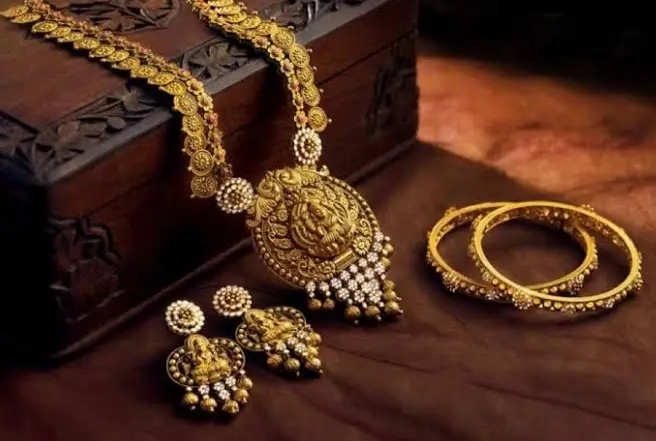

In India, jewelry is rarely just decoration. A ring, a bangle, or an anklet often carries a message about family, faith, or marriage. Traditional Indian jewelry traditions cover the whole body, from the ears to the toes. This article looks at two groups, earrings and foot ornaments, and the beliefs attached to them.
Cultural Meaning of Indian Jewelry
The cultural meaning of Indian jewelry starts with ritual. Many ornaments are worn at specific life stages. A child may receive a thin gold chain at birth. A bride receives a full set for the wedding. A married woman may keep certain pieces, such as bangles or toe rings, as signs of her status.
Jewelry also works as a family record. Gold passed from grandmother to mother to daughter carries memory as well as value. Many families can name who wore each piece and when.
Metals have meanings as well. Gold is linked with prosperity and is tied to the goddess Lakshmi in many homes. Silver is seen as cooling and pure, and it is often used for children and for the feet.
History of Indian Jhumkas
The history of Indian jhumkas stretches across centuries. The bell shape shows up in temple art, and it grew popular in royal courts. Over time, the style moved from palaces into ordinary homes.
Each region put its own mark on it. South Indian versions often use bold gold domes with ruby or pearl accents. In the north, makers added Kundan stones and enamel. In Gujarat and Rajasthan, silver jhumkas with oxidized finishes became common.
For many people, the jhumka is the first piece that comes to mind when they think of Indian jewelry. A pair of Indian earrings jhumka can pair with a saree, a kurta, or even a simple dress, which explains why the style has lasted so long.
Traditional Indian Foot Jewelry
Traditional Indian foot jewelry has its own long history. The most familiar piece is the anklet, called payal in Hindi. Other pieces include toe rings, called bichiya, and the ghungroo, a string of small bells.
Toe rings are usually worn on the second toe and are often linked with married women in many regions. They are commonly made of silver.
Foot jewelry was never an afterthought. Artisans built it for daily wear, so it had to be sturdy. Sound also played a role. Soft chimes from an anklet or ghungroo announced a person’s steps, and many households saw that sound as a sign of a lively home.
Significance of Anklets in Indian Culture
The significance of anklets in Indian culture covers belief, art, and daily life. For brides, anklets are part of the wedding set. A newly married woman’s footsteps, marked by the sound of her payal, are often welcomed as a good sign for the household.
In classical dance, anklets matter even more. Dancers of Bharatanatyam and Kathak wear ghungroo bells in tight rows. The bells keep rhythm and make each footstep part of the music.
Many families keep silver for the feet. A common belief holds that gold, linked with the goddess Lakshmi, should be worn above the waist. Not every community follows this idea, but it explains why silver anklets are so common.
A well-made Indian anklet often uses silver with small bells, chain links, or beaded patterns, and it follows the same logic as older designs.
Indian Jewelry Traditions Passed Through Families
Indian jewelry traditions often live in families. Mothers teach daughters how to wear each piece. Aunts explain what goes with which outfit. Wedding gifts follow patterns that stretch back many generations.
Some items are meant to be inherited. A pair of earrings from a grandmother may be reset in a new design, but the gold stays the same. Many families see this reuse as a way to honor those who wore it before.
The habit of gifting is part of this too. Gold coins at festivals, silver for newborns, and anklets for a first daughter are common examples.
Traditional Jewelry Across Indian Regions
Traditional jewelry across Indian regions looks different from place to place. In Bengal, married women wear shakha and pola, white conch shell and red coral bangles. In Kashmir, married Hindu women wear the dejhoor, a long gold earring suspended from the ear. In Tamil Nadu, temple jewelry uses rich gold with deity motifs. In Rajasthan, tribal women often wear heavy silver anklets and bangles that signal community and marital status.
These differences come from climate, history, and trade. Coastal areas used shells and pearls. Hill regions used silver and stone. Royal centers favored gold and gems.
Travel and migration have mixed styles over time. Still, local forms remain strong, especially at weddings and festivals.
How the Craft Has Changed
Handwork still sits at the center of this field, but the tools have changed. Casting machines speed up production. Lighter alloys make big designs easier to wear. Many makers now offer small, everyday versions of older pieces.
Some artisans worry that mass production could erase detail. Others see it as a way to reach new buyers. Both views have merit, and both shape what appears in stores today.
Why These Traditions Last
Traditional Indian jewelry traditions last because they carry more than beauty. They mark time, hold family stories, and tie people to a place. An earring or an anklet can carry a wedding, a festival, a blessing, and a memory all at once.
If you want to understand a piece, ask three questions. Where is it from? Who wore it? What does it mark? The answers tell you more than the price tag ever will.